
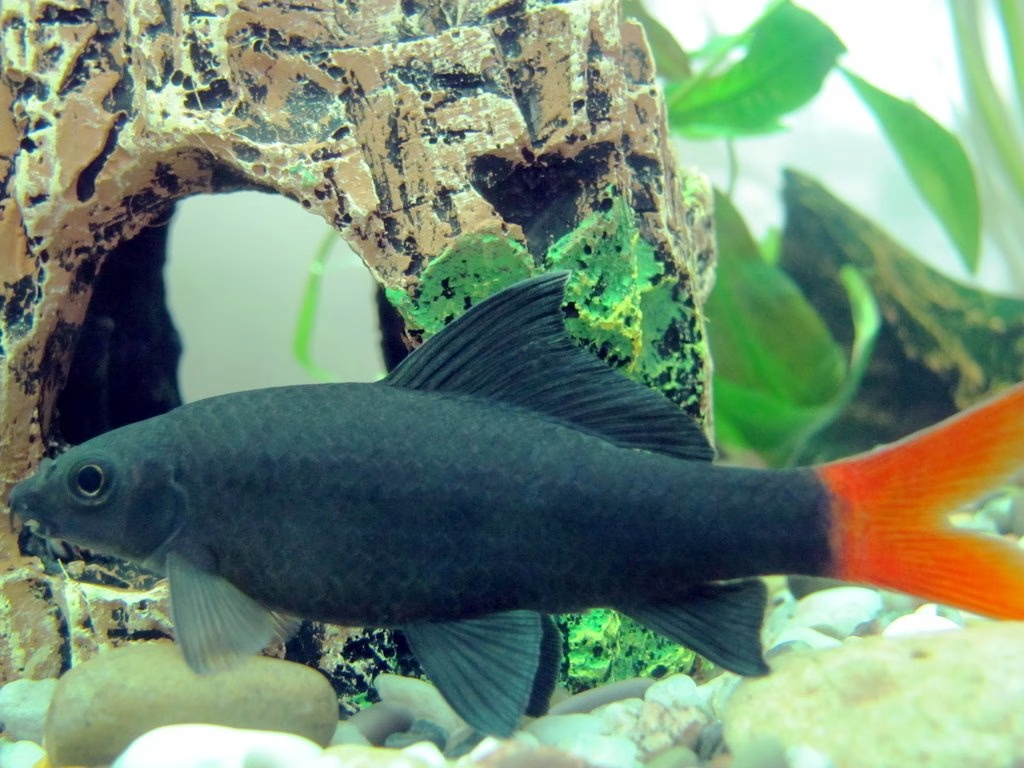
The red tailed shark is a velvet-black fish with a bright red tail. It isn’t a shark at all, but it behaves like a little landlord, patrolling and defending its patch.
| Scientific name | Epalzeorhynchos bicolor |
|---|---|
| Family | Cyprinidae |
| Origin | Chao Phraya basin, Thailand |
| Adult size | 12 to 15 cm |
| Lifespan | 5 to 8 years |
| Minimum tank | 200 litres |
| Temperature | 22 to 27°C |
| pH | 6.5 to 7.5 |
| Hardness | Up to 15 dGH |
| Swims in | Bottom |
| Temperament | Territorial, especially to similar fish |
| Group size | Keep singly |
| Diet | Omnivore: sinking pellets, algae wafers, vegetables, frozen foods |
| Difficulty | Moderate |
What it is like to keep
One per tank. Red tails become aggressive towards other red tails, rainbow sharks and similar bottom-dwellers as they mature. In a large tank with lots of cover and the right tank mates, they are stunning and active.
Sadly, the species is critically endangered in the wild; aquarium fish are farmed.
Setting up the tank
At least 200 litres and long rather than tall, with caves, rocks, wood and plants to break up sight lines. Moderate flow.
Feeding
Sinking pellets, algae wafers, vegetables and frozen bloodworm or brine shrimp.
Breeding
Not bred in home aquaria.
Tank mates
Fast mid-water fish: barbs, danios, rosy barbs, gouramis and black widow tetras. Avoid other sharks and look-alike bottom fish.
Graham’s tip: The more caves you add, the less a red tail fights. Give it more hiding spots than it can possibly guard.
More care sheets: Species Profiles. Questions? Ask in the comments below and I’ll answer.
Photo: Astellar87, CC BY-SA, via iNaturalist.
Get in touch I’d love to hear from you